
Introduction
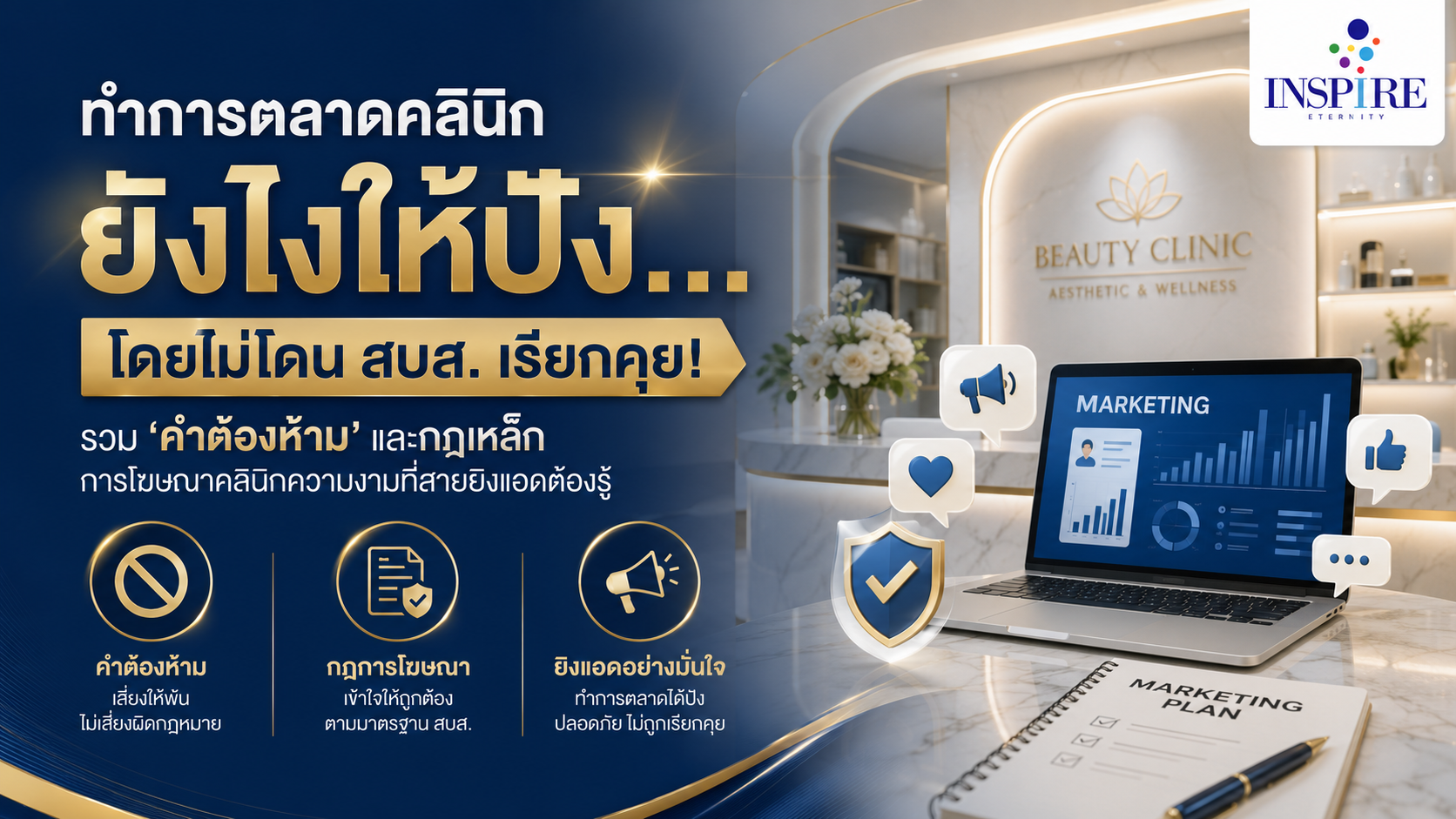
Marketing is crucial for beauty clinics in the digital age. However, medical advertising in Thailand is governed by regulations that are significantly stricter than general businesses. Many clinics run marketing campaigns without knowing that their practices are illegal, until they receive warning letters or fines.
This article compiles key medical advertising regulations, including forbidden words, HSS approval steps, before-and-after photo rules, as well as legal marketing channels to build a compliant and highly effective content strategy.
⚠️ Disclaimer: This article is for informational purposes only. The relevant laws and regulations are subject to change. We highly recommend verifying the latest guidelines directly with the HSS before launching any campaigns.
Medical Advertising Laws: Know Them Before Launching Campaigns
Medical advertising is regulated by several legal frameworks in Thailand:
- Sanatorium Act B.E. 2541 — Requires all sanatorium ads to be officially approved before publication.
- Medical Council Notification B.E. 2567 — Regulates doctors' involvement in cosmetic and aesthetic advertising.
- Ethical Penalty Criteria for Physicians B.E. 2568 (Effective Feb 9, 2025) — Outlines penalties for doctors involved in exaggerated advertising.
* Penalties to Know — Publishing ads without HSS approval carries a fine of up to 20,000 Baht, plus a daily fine of up to 10,000 Baht until the ad is suspended. (Check the latest rates with the HSS).
HSS Advertisement Approval Workflow
Every single ad creative—including Facebook posts, TikTok videos, Instagram updates, website banners, or offline brochures—must follow this workflow:
| Step | Details |
|---|---|
| 1. Prepare Ad Content | Create the exact copy, images, and videos planned for publishing. |
| 2. Apply for Approval | Submit the application forms to the HSS (Bangkok) or SSJ (provinces) along with the ad copy. |
| 3. Official Review | Officers inspect the text and visual content against advertising regulations. |
| 4. Receive License Number | Once approved, a license number is issued, which must be clearly displayed on the ad. |
| 5. Publish Advertisement | Publish the exact approved content. No edits are allowed after approval. |
⚠️ Note: Each clinic branch must apply for its own ad license number. Sharing a license number across multiple branches is illegal.
Forbidden Words and Statements in Medical Ads
The HSS maintains lists of prohibited terms. Below are the most common groups that cause applications to be rejected:
Group 1 — Superiority Claims
- 'Best', 'No.1', 'Superior', 'The Greatest'
- 'First Ever', 'World Class', 'Leading'
- 'Guru', 'Miracle Doctor'
⚠️ Note: The Medical Council B.E. 2567 guidelines prohibit physicians from advertising themselves as having specialized experience or expertise specifically in cosmetic or aesthetic medicine.
Group 2 — Guarantee of Results
- 'Immediate Results', '100% Cured', 'Guaranteed Outcome'
- '100% Safe', 'Zero Side Effects'
- 'Perfect Look', '99% Satisfied'
Group 3 — Drugs & Medical Devices
- Prohibited to mention dangerous or controlled drug names directly. Use generic program names like \"Botulinum Toxin Program\" or \"Filler Program\" instead of brand names.
- Prohibited to show product vials, barcodes, or QR codes.
- Prohibited to list medical device specifications or health benefits in ad creatives.
- Physicians are prohibited from posing with medical devices (violates Medical Council code of ethics).
Group 4 — Research and Statistics
- Prohibited to cite statistics or research papers without verified, verifiable citations.
- Prohibited to use percentage claims without supporting data.
* Forbidden word lists are subject to update. Check the HSS official site (hss.moph.go.th) for the latest list before creating ads.
Before-After Photos: Are They Allowed?
Before-and-after photos are the most common query for beauty clinics. The answer is: Yes, but under strict statutory conditions:
- Every before-and-after photo set must be approved by the HSS before publication.
- Written patient consent forms must be obtained and kept on record.
- Photos must be completely truthful—no filtering, retouching, or editing, and must state that results vary by individual.
- Before-and-after photos cannot be used to guarantee treatment outcomes.
⚠️ Warning: Posting a before-and-after comparison on social media without a valid HSS license number is illegal, even if the patient gave consent.
Reviews and Testimonials
Customer reviews can be used in marketing, provided you meet these criteria:
- Written consent from the reviewer must be obtained.
- Reviews must not be edited or embellished.
- Reviews must state that outcomes are individual and not guaranteed.
- Patients must be informed that their reviews will be used for marketing purposes.
Legal Marketing and Content Channels
Despite strict rules, clinics can deploy powerful legal channels to build trust and brand awareness:
Educational Content
Providing genuine knowledge on skincare, aesthetic technology, or pre-and-post treatment care is highly effective. Since it is educational and not promotional, it builds authority without violating rules:
- Articles explaining how technologies work.
- Videos showing post-care tips.
- Infographics comparing technologies neutrally.
Google Business Profile
Optimizing your Google Business Profile with location, hours, contact number, and site photos is fully compliant and highly effective for local search visibility.
LINE Official Account
Using LINE OA to coordinate appointments and handle inquiries is fully legal. However, broadcast messages containing promotional offers must still hold a valid HSS ad license number.
SEO and Content Marketing
Publishing educational blog articles on your website is a powerful long-term strategy. True informational content is not classified as advertising, provided it avoids overclaiming or result guarantees.
Summary: Allowed vs. Regulated vs. Prohibited
| Fully Allowed | Regulated (HSS Approval Required) | Prohibited |
|---|---|---|
| Informational/Skincare articles | All promotional/ad copy | Unlicensed advertisements |
| Google Business Profile listing | Before-and-after photos | Outcome guarantees |
| Direct patient Q&A replies | Customer review posts | Superlative/boastful words |
| SEO blog content | Promotional offers/packages | Listing restricted drug brands |
| Operating hours & address info | Clinic introduction videos | Exaggerating minor side effects |
Frequently Asked Questions (FAQ)
Q: Do educational posts require HSS approval?
Purely informational posts that do not promote clinic services, prices, or special offers do not require approval. However, if they reference the clinic's own treatments, they cross into advertising. When in doubt, consult the HSS.
Q: Do influencer reviews require approval?
Yes. Influencer reviews paid via cash or free treatments are classified as advertising and must go through the HSS approval process before publication.
Q: Do Facebook/TikTok live streams require approval?
Yes, if they promote the clinic's services or programs. Live streams are closely audited, so it is recommended to get HSS guidance on live format parameters.
Q: What if our ad application is rejected?
The HSS will issue a rejection notice specifying the items to amend. You can correct the copy or images and resubmit. Working with compliance experts saves time.
Conclusion
Marketing a beauty clinic in Thailand requires careful compliance, but this doesn't mean you can't run successful campaigns. Understanding rules from the start allows you to build a content system that builds trust and authority legally.
Clinics that focus on compliance and educational authority build stronger customer loyalty over time than those relying on short-term exaggerated claims.